
Sugar Rush 2 Mechanics
Sugar Rush 2 is the sequel to one of the most recognizable grid-based slots developed by Pragmatic Play. The game expands on the cascading reels system, multiplier progression, and bonus structure that made the original title successful.
Unlike traditional 5×3 reel slots, Sugar Rush 2 operates on a 7×7 grid system, where symbols land randomly across 49 positions. The gameplay revolves around cluster wins, progressive multipliers, cascading mechanics, and a retrigger-friendly Free Spins round.
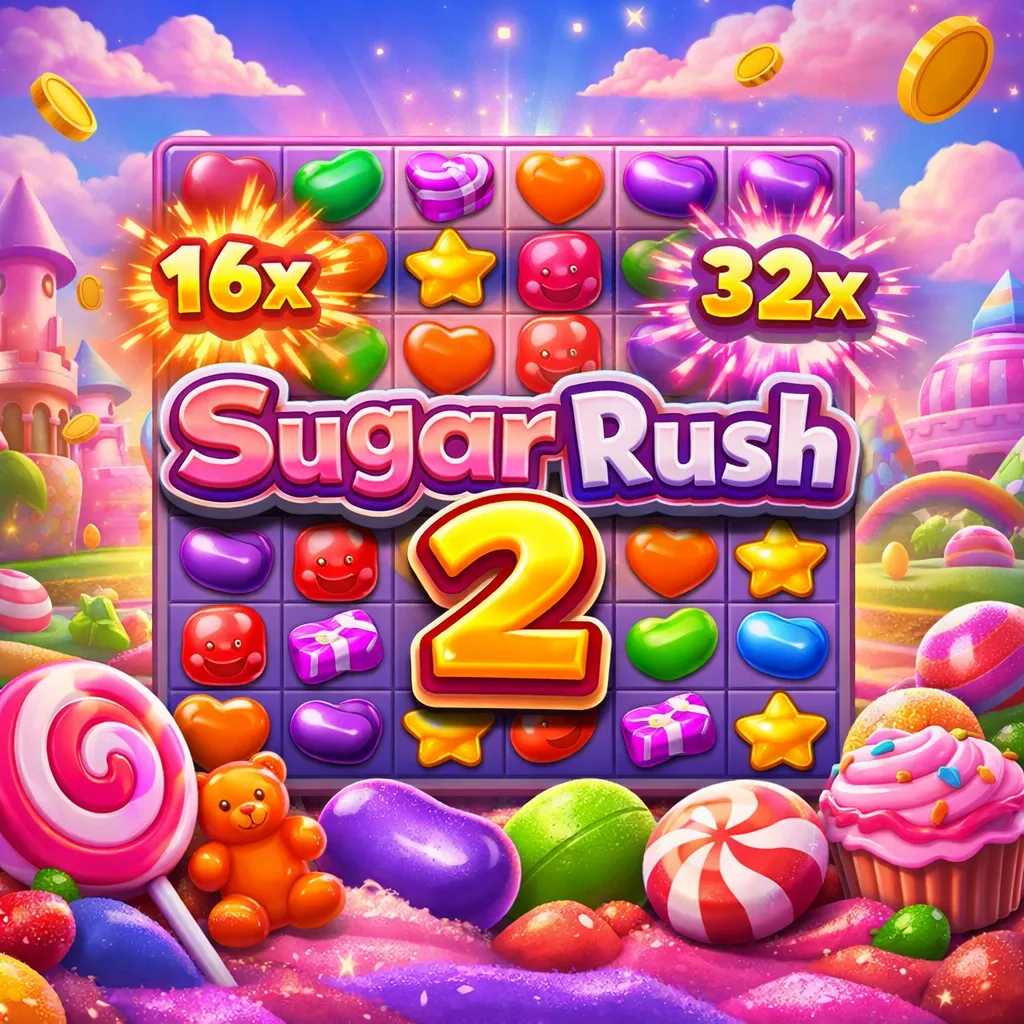
This article provides a complete breakdown of:
- Core gameplay structure
- Cluster mechanics and win calculations
- Multiplier system logic
- Scatter functionality
- Free Spins mechanics
- Volatility model
- RTP structure
- Probability behavior
- Comparison with the original version
- Strategic considerations for players
The goal is to explain how every mechanical component interacts inside the system.
Core Gameplay Structure
Sugar Rush 2 uses a 49-cell grid layout (7×7) with cluster-based payouts. There are no paylines. Instead, wins are formed when 5 or more identical symbols connect horizontally or vertically.
Basic Rules
- Minimum cluster: 5 matching symbols
- Symbols must touch horizontally or vertically
- Diagonal connections do not count
- Winning symbols disappear after payout
- New symbols cascade down to fill empty positions
This cascade system creates the possibility of multiple consecutive wins within a single spin.
Cluster Win Mechanics Explained
Cluster-based slots calculate payouts differently than line-based slots.
How Clusters Are Counted
If 5 or more identical symbols connect:
- 5–7 symbols = Small payout
- 8–11 symbols = Medium payout
- 12+ symbols = Large payout
Each cluster payout is multiplied by the current bet amount.
After the win:
- Symbols disappear
- Empty spaces are filled
- Multipliers increase (explained below)
- A new win evaluation occurs
This repeats until no new clusters form.
Progressive Multiplier System
One of the defining mechanics in Sugar Rush 2 is the persistent multiplier grid system.
Each position on the 7×7 grid can hold an individual multiplier.
Multiplier Behavior
- Every time a symbol participates in a winning cluster, that position increases its multiplier.
- Multipliers stack progressively.
- Multipliers remain active during cascades.
- In Free Spins mode, multipliers persist for the entire bonus round.
Multiplier progression typically increases in steps such as:
1x → 2x → 4x → 8x → 16x → 32x → 64x → 128x
There is no global multiplier. Each cell tracks its own multiplier independently.
This creates exponential win potential if repeated clusters hit the same grid area.

Scatter and Bonus Trigger Mechanics
Scatter symbols do not need to connect.
Bonus Trigger
- 4 Scatter symbols = 12 Free Spins
- Additional Scatters during Free Spins = +5 spins per extra Scatter
Scatters can land anywhere on the grid.
The bonus round is where the multiplier system becomes significantly more powerful.
Free Spins Mechanics
The Free Spins round retains the core cascading and multiplier logic but introduces persistent accumulation.
Key Features
- Grid multipliers do not reset between spins
- All existing multipliers remain active
- Retriggers are unlimited
- High multiplier stacking is possible
Because multipliers accumulate across spins, late-bonus spins often produce higher volatility behavior.
This mechanic shifts the volatility curve upward during the bonus round.
RTP and Volatility Structure
Sugar Rush 2 typically offers RTP settings ranging around 96.5% (configurable by operator).
Volatility classification: High
High volatility implies:
- Fewer but larger wins
- Strong dependence on bonus performance
- Significant multiplier-based spikes
Below is a volatility behavior visualization.
Interactive Volatility Curve
This chart demonstrates how expected payout frequency behaves compared to multiplier escalation.
Probability Distribution Model
High volatility grid slots typically follow a skewed payout distribution:
- High frequency of small cluster wins
- Medium frequency of moderate cascade sequences
- Low frequency of high multiplier stacking events
This mathematical structure explains why large wins are heavily tied to bonus performance.
Comparison With the Original Sugar Rush
Sugar Rush introduced the multiplier grid system.
Sugar Rush 2 modifies:
- Enhanced retrigger logic
- More aggressive multiplier stacking
- Higher maximum win potential
- Adjusted scatter frequency
The sequel is designed for greater peak volatility.
Feature Summary Table
Grid Size
7×7 Cluster System
Minimum Cluster
5 Symbols
Volatility
High
Bonus Trigger
4 Scatters = 12 Free Spins
Authoritative Gambling Research Sources
Regulatory & Probability Research
UK Gambling Commission
Official regulatory guidelines on RTP transparency and fairness testing.
Visit WebsiteIndustry Data & Slot Analysis Platforms
Multiplier Growth Modeling
In high-volatility grid systems like Sugar Rush 2:
Expected Value = (Cluster Frequency × Avg Multiplier × Bet Size)
Because multipliers increase non-linearly, late-bonus sequences have higher variance.
This explains why:
- Most base spins yield modest returns
- Bonus rounds determine long-term RTP performance
- Multiplier stacking zones become statistically significant
Structural Mathematical Observations
The game uses:
- Pseudorandom number generator (PRNG)
- Weighted symbol distribution
- Dynamic cluster probability mapping
The presence of 49 independent grid positions increases combinational outcomes compared to a 5×3 slot.
This drastically increases state-space complexity.
Strategic Considerations
- Bankroll management is essential due to volatility
- Bonus entry frequency affects session variance
- Multiplier zones near the center grid statistically produce higher cascade potential
Understanding mechanics improves expectation alignment.
Symbol Distribution Architecture
In a 49-cell grid slot, each spin begins with a fully randomized grid outcome generated by a PRNG (Pseudorandom Number Generator). The number of possible combinations is significantly larger than in traditional 5×3 slots.
If we simplify and assume 10 base symbols (not counting scatters), the theoretical outcome space becomes:
10^49 possible raw combinations
In reality, symbol weighting reduces this space through probability bias. Lower-value symbols typically appear more frequently than high-value symbols.
Weighted Symbol Logic
- Low symbols → high appearance probability
- Premium symbols → lower probability
- Scatter symbols → independent trigger probability
This weighting directly influences:
- Base game hit frequency
- Average cluster size
- Bonus entry rate
- Volatility curve slope
The 7×7 grid increases adjacency probability compared to 5×5 or 5×3 cluster models. More neighboring cells means more potential cluster formation paths.
Cluster Formation Probability
Cluster slots rely on adjacency logic rather than paylines. For a 5-symbol cluster to occur:
- Identical symbols must appear
- They must connect horizontally or vertically
- The cluster must reach minimum threshold size
Why Clusters Cascade
After a winning cluster:
- Symbols disappear
- Empty positions collapse downward
- New symbols are inserted from above
This introduces conditional probability.
The probability of a second win after a cascade is not independent from the first event. The grid structure changes.
This cascading dependency creates volatility amplification.
Multiplier Grid Accumulation Theory
Sugar Rush 2 uses position-based multiplier tracking.
Each winning symbol position increments its multiplier value.
The critical mathematical behavior here is exponential growth.
If a symbol hits repeatedly in the same grid location:
1x → 2x → 4x → 8x → 16x → 32x → 64x → 128x
The effective payout formula becomes:
Cluster Payout × Sum of Active Multipliers in Cluster
If multiple high multipliers overlap inside a single cluster, payout spikes rapidly.
Why Bonus Mode Is Volatile
In Free Spins:
- Multipliers do not reset between spins
- Accumulation compounds across the session
This converts the volatility model from high to extreme in later bonus stages.
Early bonus spins often act as “setup spins”.
Late spins act as “execution spins”.
Bonus Retrigger Probability Model
The Free Spins round is triggered by 4 scatter symbols.
Once inside bonus mode:
- Additional scatters add +5 spins
- No upper retrigger limit
Retrigger frequency determines:
- Total bonus length
- Multiplier accumulation potential
- Probability of 100x+ events
Because multipliers persist, longer bonuses statistically correlate with higher payout ceiling.
However, retrigger probability is weighted lower than base trigger probability.
Long Session Variance Simulation
Below is a theoretical volatility behavior curve across 500 simulated spins. This does not represent real RTP data. It visualizes expected distribution shape.
This illustrates typical high-volatility behavior:
- Extended drawdown periods
- Sudden spike events
- Non-linear recovery
RTP Configuration & Regulatory Context
RTP (Return to Player) values are determined by the game provider and can be configured by operators.
Independent auditing authorities validate slot fairness and RNG integrity.
Industry Data & Analytical References
Grid Interaction Theory
Because the grid contains 49 dynamic cells:
- Central positions statistically have more adjacency neighbors
- Edge positions have fewer connection paths
- Cluster expansion probability increases toward center
This spatial property subtly influences cascade expansion likelihood.
Repeated cluster hits in central zones increase multiplier density faster.
High Multiplier Event Dynamics
A large win scenario generally requires:
- Bonus mode activation
- At least one retrigger
- Multiplier stacking above 16x in multiple adjacent cells
- Large cluster overlapping those multipliers
This chain event probability is low but mathematically possible.
Such events define high volatility identity.
Session Behavior Summary (Without Conclusion)
Over short sessions:
- Results fluctuate strongly
- Bonus entry variance dominates
Over medium sessions:
- RTP begins smoothing toward theoretical value
Over long sessions:
- Extreme spikes balance extended dry periods
The structural identity of Sugar Rush 2 remains:
Cluster-driven
Cascade-amplified
Multiplier-exponential
Bonus-dependent
High variance
Expected Value (EV) Structural Model
In simplified form:
EV per spin = (Base Win Frequency × Avg Base Win Size)
- (Bonus Trigger Probability × Avg Bonus Value)
Where:
Avg Bonus Value = (Avg Spins × Avg Multiplier Density × Avg Cluster Size)
Because multipliers accumulate and persist in Free Spins, the bonus component often accounts for a disproportionate share of total RTP.
High-volatility slots frequently allocate:
- 30–40% RTP to base game
- 60–70% RTP to bonus feature
This distribution increases variance because bonus access is probabilistic.
Multiplier Density Growth Model
Each grid position tracks its own multiplier independently.
Let’s define multiplier density (MD):
MD = Sum of all active multipliers on grid / 49
During base game:
MD resets after each spin.
During Free Spins:
MD accumulates progressively.
Example:
Spin 1 → 6 winning positions → average multiplier 2x
Spin 2 → overlapping hits → some positions rise to 4x
Spin 5 → multiple cells reach 8x+
By Spin 10, MD may double or triple relative to early bonus state.
This exponential stacking is the mathematical foundation of large payouts.
Spatial Adjacency Efficiency
A 7×7 grid creates uneven adjacency distribution.
- Corner cells → 2 adjacent neighbors
- Edge cells → 3–4 neighbors
- Central cells → 4 neighbors
Cluster formation probability increases with adjacency count.
Central zones therefore:
- Have higher cascade expansion likelihood
- Accumulate multipliers more efficiently
- Produce stronger overlap potential
Over extended bonuses, high-multiplier clusters statistically appear closer to the center.
Bonus Round Length Distribution
The bonus starts with 12 spins.
Each additional scatter grants +5 spins.
Let:
P(r) = Probability of retrigger
Expected bonus length (EBL) becomes:
EBL = 12 + (P(r) × 5) + (P(r)^2 × 5) + …
This geometric series expands variance rapidly.
Even small retrigger probability dramatically increases theoretical bonus value.
Longer bonus → higher multiplier density → non-linear payout escalation.
Risk Curve Modeling
High-volatility games follow skewed distribution.
Most sessions:
- Small losses
- Moderate losses
- Occasional recovery spikes
Rare sessions:
- Large exponential wins
Below is a responsive interactive model visualizing payout probability tiers.
This demonstrates classic high-volatility skew:
Frequent low-tier outcomes
Rare high-tier spikes
RTP Convergence Over Time
RTP is theoretical and calculated over millions of spins.
Short-term RTP deviation can be significant.
Over extended cycles:
- Variance smooths
- Distribution approaches configured RTP
Regulatory bodies require RNG certification and fairness validation.
UK Gambling Commission Technical Standards
Remote Gambling and Software Technical Standards documentation.
View DocumentationMultiplier Overlap Probability
Large wins require overlapping conditions:
- High MD (multiplier density)
- Large cluster size
- Overlapping multiplier zones
- Late bonus spin timing
Probability of simultaneous overlap is low.
But because multipliers compound, payout increase is multiplicative, not additive.
This produces the characteristic Sugar Rush 2 volatility spike.
Behavioral Engagement Architecture
Grid-based cascade slots are structured to create:
- Continuous motion
- Progressive tension buildup
- Visual reinforcement of multiplier growth
Psychological reinforcement loop:
Small win → cascade → multiplier increment → anticipation → repeat
In bonus mode:
Persistent multipliers enhance perceived momentum.
The anticipation curve rises with each spin as MD increases.
Long-Term Session Modeling
Over 1,000+ spins:
- Base volatility stabilizes
- Bonus frequency aligns with theoretical probability
- RTP approaches long-term configured value
However, short sessions remain dominated by randomness.
High-volatility cluster slots therefore favor:
- Larger bankroll buffers
- Variance tolerance
- Patience during base cycles
Monte Carlo Simulation Framework
Monte Carlo modelling simulates thousands or millions of spins to approximate expected long-term performance.
For a high-volatility 7×7 cluster slot, simulation typically tracks:
- Base hit frequency
- Average cascade length
- Bonus trigger rate
- Average bonus value
- Multiplier density progression
- Maximum win frequency
If we model 1,000,000 simulated spins:
- Base game contributes steady low-tier returns
- Bonus events create irregular spikes
- A small percentage of bonus rounds generate disproportionate RTP share
This skew is what defines the risk curve of Sugar Rush 2.
RTP Allocation Layering
High-volatility cluster slots often distribute RTP across structural layers.
Layer 1 – Base Cluster Wins
Layer 2 – Base Cascades
Layer 3 – Bonus Trigger Value
Layer 4 – Multiplier Accumulation
Layer 5 – Extreme Overlap Events
The majority of theoretical RTP comes from bonus-layer multipliers.
For example (theoretical structure):
- 35% RTP from base interactions
- 65% RTP from Free Spins
Inside the bonus RTP layer:
- 50% from standard multiplier growth
- 30% from retrigger extension
- 20% from high-density multiplier overlap events
This explains why bonus entry is statistically critical for RTP alignment.
Cascade Depth Probability Matrix
Cascade depth refers to how many consecutive wins occur during one spin.
Let C represent cascade count.
Typical distribution in cluster-based high volatility models:
C = 1 → Very common
C = 2 → Moderate
C = 3 → Less common
C ≥ 4 → Rare
Each additional cascade increases multiplier density locally.
Probability decreases geometrically with each cascade iteration.
However, during Free Spins, cascade depth becomes more valuable because multipliers persist.
Extreme Win Architecture
Large wins in Sugar Rush 2 require synchronized structural alignment.
Required conditions:
- Free Spins active
- Multiplier density above mid-threshold
- At least one retrigger
- Large premium cluster
- Cluster overlaps multiple high multipliers
This event stack forms a conditional chain.
If each condition has independent probability p1, p2, p3, p4, p5:
Extreme Event Probability ≈ p1 × p2 × p3 × p4 × p5
Because each factor is already relatively low, the final probability is very small.
That small probability defines the game’s high volatility classification.
Multiplier Density Escalation Curve
Multiplier density (MD) does not grow linearly.
Early bonus spins → gradual growth
Mid bonus → exponential stacking begins
Late bonus → potential saturation zones
The nonlinear nature comes from repeated hits in overlapping spatial areas.
If central cells accumulate 16x+ multipliers, overlapping cluster events multiply payout dramatically.
Grid Saturation Dynamics
Grid saturation occurs when multiple high multipliers occupy adjacent cells.
At saturation threshold:
- Any medium-sized cluster landing in that region spikes payout
- Risk curve becomes sharply asymmetric
However, saturation is temporary because:
- Bonus round ends
- Grid resets
This creates sharp variance spikes instead of sustained high-return periods.
Comparison With Original Sugar Rush
Sugar Rush introduced the persistent multiplier grid in bonus mode.
Sugar Rush 2 modifies volatility through:
- Slightly more aggressive multiplier progression
- Enhanced retrigger synergy
- Higher maximum win ceiling
- Adjusted scatter weighting
The sequel increases tail-risk exposure, meaning extreme events are rarer but larger.
Variance Over 10,000 Spin Cycle
Over short cycles (100–300 spins):
High deviation from theoretical RTP is common.
Over 1,000 spins:
Bonus frequency stabilizes.
Over 10,000 spins:
Distribution begins converging toward theoretical return.
But even at 10,000 spins:
Variance remains noticeable due to heavy-tail payout structure.
High volatility games require far larger sample sizes for tight RTP convergence compared to low-volatility line slots.
Regulatory Oversight & RNG Integrity
All licensed versions of Sugar Rush 2 must comply with regulatory technical standards.
Regulators require:
- RNG unpredictability
- RTP compliance within tolerance
- Transparent configuration ranges
- Game logic integrity
Risk Modeling and Bankroll Stress
High-volatility cluster slots exhibit:
Extended neutral cycles
Sharp upward spikes
Occasional rapid drawdowns
Bankroll stress increases when:
- Bonus triggers are delayed
- Retriggers fail to occur
- Multiplier density stagnates
Stress decreases when:
- Bonus frequency aligns with expectation
- Multiplier stacking accelerates
This cyclical stress pattern defines engagement behavior.
Long-Tail Distribution Characteristics
Sugar Rush 2 follows a long-tail payout distribution.
Most outcomes cluster around low multiples of stake.
A small percentage generate extremely high multiples.
This distribution resembles:
Right-skewed heavy-tail curve
Such games are designed to provide:
High excitement potential
Low predictability
Strong volatility identity