
Sugar Rush 2 For players
Sugar Rush 2 is the sequel to one of the most recognizable grid-based online slots of recent years. Developed by Pragmatic Play, this candy-themed game builds on the mechanics that made the original popular while adding deeper multipliers, refined bonus dynamics, and enhanced volatility.
Game Overview
Provider: Pragmatic Play
Grid: 7×7 cluster pays
Maximum Win: 5,000x stake
Volatility: High
RTP: Commonly 96.50% (check casino version)
Bet Range: Varies by operator
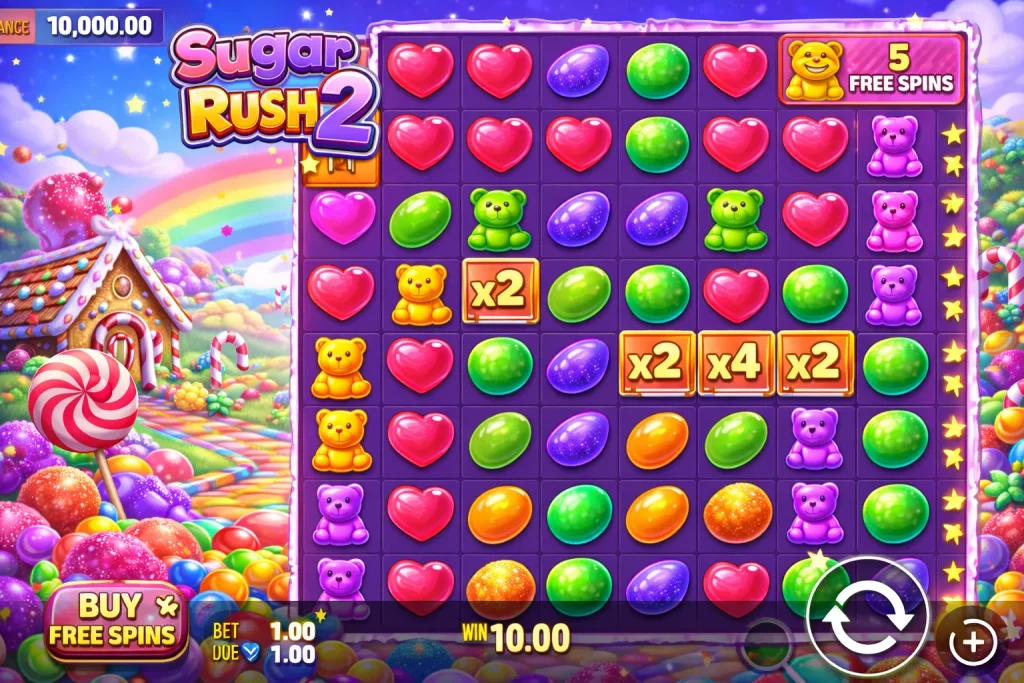
Unlike traditional five-reel slots, Sugar Rush 2 uses a 7×7 grid and cluster pays. Wins occur when five or more matching symbols connect horizontally or vertically. There are no paylines. Instead, adjacency determines payout qualification.
When a winning cluster forms, the symbols disappear and new ones fall into place. The grid positions involved in the win receive multipliers, which can increase if subsequent wins occur on the same positions.

This cascading structure creates extended spin sequences and drives volatility.
Core Mechanics
The cluster pay system changes the probability model compared to line-based slots. Outcomes depend on adjacency distribution rather than reel alignment.
Winning cluster tiers:
- 5–6 symbols
- 7–9 symbols
- 10–14 symbols
- 15 or more symbols
Each time a cluster wins, those positions receive a multiplier:
- First activation: x2
- Second activation: x4
- Third activation: x8
- Fourth activation: x16
In the base game, multipliers apply only within the same spin. During Free Spins, they persist across spins, significantly increasing win potential.
RTP and Volatility Analysis
Return to Player (RTP) reflects the long-term theoretical payout percentage. Sugar Rush 2 typically operates at 96.50%, although this can vary by operator configuration.
The slot is categorized as high volatility. This means:
- Extended dry streaks are possible
- Bonus rounds contribute heavily to RTP
- Win distribution is skewed toward larger, less frequent payouts
High volatility requires disciplined bankroll management and expectation control.
Interactive RTP & Volatility Visualization
The chart below is responsive and optimized for both desktop and mobile environments.
Sugar Rush 2 – RTP & Volatility Overview
Base RTP
Bonus Weight
Volatility
Max Win Scale
Free Spins Feature
Free Spins are triggered by landing 3, 4, or 5 scatter symbols.
Typical structure:
- 3 scatters: 10 spins
- 4 scatters: 12 spins
- 5 scatters: 15 spins
During Free Spins:
- Position multipliers persist between spins
- Retriggers are possible
- The grid can accumulate high-multiplier clusters
This persistent mechanic is the main driver of large win potential. When multiple cascades occur on previously activated positions, exponential payout scaling becomes possible.
Bankroll Management for High Volatility Slots
High-volatility games require a structured bankroll approach.
Recommended considerations:
- Allocate at least 150–250 spins per session
- Avoid aggressive stake escalation
- Define stop-loss and session limits
- Understand that bonus rounds may be infrequent
Responsible gambling standards are regulated by organizations such as:
- UK Gambling Commission
- Malta Gaming Authority
These authorities enforce transparency, RTP disclosure, and player protection requirements.
Regulatory and Authoritative Gambling Resources
Demo Mode vs Real Money Play
Sugar Rush 2 is typically available in demo mode and real-money mode.
Demo mode allows players to:
- Observe multiplier stacking
- Track scatter frequency
- Analyze volatility patterns
However, demo environments do not replicate emotional risk exposure.
Experienced players often use demo sessions to evaluate spin frequency and bonus trigger distribution before transitioning to real wagering.
Industry Research and Analytical Platforms
Comparable Slots
Other multiplier-driven or cluster-based slots include:
- Gates of Olympus
- Sweet Bonanza
Sugar Rush 2 differentiates itself through persistent grid multipliers that accumulate positionally rather than globally.
Technical Performance
The slot runs on HTML5 architecture, ensuring:
- Full mobile compatibility
- Cross-browser stability
- Optimized load speeds
- Touchscreen interface responsiveness
The 7×7 grid adapts smoothly to vertical mobile layouts without horizontal scroll distortion.
Player Profile Suitability
Sugar Rush 2 is generally suited for:
- Experienced slot players
- Bonus-focused players
- High-volatility enthusiasts
- Medium to large bankroll segments
It may be less appropriate for players seeking low-risk, steady-return gameplay.
Core Mechanics in Detail
The most important difference between Sugar Rush 2 and traditional reel slots lies in its structural mechanics.
The game runs on a 7×7 grid. Instead of paylines, wins are triggered by clusters of five or more matching symbols connected horizontally or vertically. Diagonal connections do not count.
Each winning cluster activates multipliers on the exact positions where the win occurred.
Multiplier progression:
- First activation: x2
- Second activation: x4
- Third activation: x8
- Fourth activation: x16
In the base game, multipliers reset after each spin. During Free Spins, they persist across spins, dramatically changing expected payout potential.
This persistence mechanic shifts a large percentage of RTP into the bonus phase.
Structural Characteristics of the Slot
Understanding the characteristics of Sugar Rush 2 helps players anticipate variance behavior.
Game Structure Characteristics:
High Volatility
The slot is designed to produce uneven payout distribution. Smaller wins occur intermittently, while large payouts are concentrated in bonus rounds.
Bonus-Weighted RTP
A significant portion of the theoretical 96.50% RTP is allocated to Free Spins. This means base game returns may feel lower over short sessions.
Cluster Probability Model
Unlike reel-strip models, adjacency clustering increases randomness in symbol grouping. This increases variance unpredictability.
Exponential Multiplier Growth
Because multipliers stack positionally, the payout curve during Free Spins is not linear. When cascades repeatedly hit previously activated cells, payout potential increases exponentially.
Maximum Win Cap
The game is capped at 5,000x stake, creating a defined upper volatility ceiling.
Free Spins – Mathematical Behavior
Free Spins are triggered by landing three or more scatter symbols anywhere on the grid.
Typical structure:
- 3 scatters = 10 spins
- 4 scatters = 12 spins
- 5 scatters = 15 spins
Key mechanics during bonus:
Multipliers persist across spins
Retriggers are possible
Cluster frequency can accelerate payout momentum
When several cascades hit already-multiplied positions, payout amplification compounds rapidly.
Players often underestimate how important grid positioning is during bonus rounds. A well-placed early cascade can define the entire bonus session.
Bonus Buy Option – Risk Profile
In many licensed casinos, Sugar Rush 2 includes a Bonus Buy feature.
This allows direct purchase of the Free Spins round at a fixed multiplier of the stake.
Important characteristics of bonus buy:
Higher variance exposure
Shortened gameplay cycle
Immediate RTP concentration
While it can save time, it significantly increases bankroll volatility. Professional players treat bonus buys as high-risk entries rather than routine gameplay.
Demo Mode – How to Use It Properly
The Demo version of Sugar Rush 2 is not just for casual play. It can be a powerful analytical tool.
Available in many regulated casinos, Demo mode allows players to:
Test cluster frequency
Track scatter appearance rate
Measure multiplier stacking frequency
Observe volatility swings without financial risk
However, Demo gameplay should be used strategically.
Recommended Demo testing method:
Run 300–500 spins
Track average spin return
Record bonus trigger frequency
Observe how often multipliers reach x8 or x16
While Demo outcomes are random and not predictive, long sessions can provide insight into volatility rhythm.
It is important to understand that Demo mode uses the same mechanics and RNG structure as the real-money version, provided the casino is licensed by authorities such as:
- UK Gambling Commission
- Malta Gaming Authority
Always verify RTP configuration at the specific operator, as some casinos may use alternative RTP versions.
Volatility Behavior Over Extended Sessions
Sugar Rush 2 is engineered to produce streak-based momentum.
Common session patterns:
Extended low-return base game
Sudden bonus trigger
High-multiplier cascade within 3–5 bonus spins
Occasional retrigger extending volatility cycle
Because of its structural characteristics, session length plays a major role in perceived performance.
Short sessions amplify volatility impact.
Longer sessions smooth variance but require disciplined bankroll allocation.
Comparison with Similar Mechanics-Based Slots
Sugar Rush 2 shares certain multiplier DNA with:
- Sweet Bonanza
- Gates of Olympus
However, those titles apply multipliers globally. Sugar Rush 2 applies them positionally. That structural difference increases strategic observation value during gameplay.
Bankroll Allocation Strategy
Because of its volatility characteristics, bankroll management becomes essential.
Suggested approach:
Allocate 200+ spins worth of budget
Avoid doubling stake after losses
Treat bonus buys as separate high-risk segments
Use Demo mode before increasing stake level
Players who approach the game analytically tend to maintain longer session stability.
Technical Characteristics and Performance
Sugar Rush 2 operates on HTML5 architecture, making it fully compatible with:
Desktop browsers
Mobile browsers
Tablet interfaces
Load performance is generally smooth, even on mid-range devices. The 7×7 grid adapts cleanly to vertical mobile screens.
The interface remains stable during high-multiplier cascade animations, which is important in bonus rounds where multiple calculations occur rapidly.
Psychological Design Elements
The slot’s candy-themed design contrasts with its high volatility mechanics.
Bright visuals reduce perceived risk tension.
Multiplier animations create anticipation loops.
Persistent grid markers encourage focus tracking.
This design combination increases engagement time.
Players should remain aware that visual stimulation does not reduce underlying mathematical volatility
Advanced Player Suitability
Sugar Rush 2 is best suited for:
Players comfortable with variance
Bonus-focused gameplay enthusiasts
Medium to large bankroll holders
Analytical players who track performance
It is less suitable for low-volatility preference players seeking steady incremental returns.
Session Volatility Curve – Linear Projection
High-volatility slots rarely behave evenly across short sessions. Instead, they demonstrate irregular momentum shifts.
Below is a simplified session flow model showing how volatility typically behaves across 300 spins.
Session Volatility Curve (300 Spin Model)
This simplified line graph reflects a common high-volatility pattern:
Low-return base game
Sudden bonus spike
Partial regression
Occasional secondary spike
The curve is uneven because most RTP weight sits inside Free Spins.
Bonus Distribution Characteristics
Sugar Rush 2 distributes theoretical return unevenly between base and bonus phases.
Typical structural characteristics:
Base Game Contribution – Moderate
Bonus Contribution – High
Retrigger Probability – Medium
High Multiplier Frequency – Low but impactful
Below is a visual breakdown.
RTP Distribution Breakdown
Base Game
Free Spins
Retriggers
High Multiplier Hits
Multiplier Growth Dynamics
Unlike global multiplier slots such as Sweet Bonanza, Sugar Rush 2 accumulates power at specific grid cells.
If a cell hits multiple cascades:
x2 → x4 → x8 → x16
Probability of repeated hits on the same cell is relatively low. However, when early cascades occur in bonus, the expected value of subsequent spins increases.
This creates an accelerating payout curve rather than a flat distribution.
Circular Distribution – Win Type Share
The following pie-style chart models how different win sizes typically distribute in high-volatility cluster slots.
Win Size Distribution Model
Distribution model:
Small Wins – Frequent
Medium Wins – Occasional
Large Wins – Rare
Max Win Events – Extremely Rare
This distribution is typical of high-volatility slots regulated under authorities such as the UK Gambling Commission and Malta Gaming Authority.
Advanced Characteristics Summary
Sugar Rush 2 shows these defining characteristics:
High variance scaling
Bonus-heavy RTP concentration
Exponential multiplier stacking
Position-based growth modeling
Defined 5,000x win ceiling
The Demo version allows observation of volatility rhythm, but it does not reduce structural risk in real-money sessions.
Long-Term Player Suitability
Sugar Rush 2 is most appropriate for:
High-variance players
Bonus hunters
Bankrolls prepared for 200+ spin exposure
Players comfortable with delayed reward structures
It is less suitable for low-risk session seekers.
500-Spin Probability Model – Capital Flow Curve
High-volatility slots do not distribute returns evenly. Over 500 spins, capital movement often follows irregular cycles rather than linear decline.
Below is a simplified long-session capital fluctuation model.
500 Spin Capital Flow Simulation
Observed pattern characteristics:
Extended drawdown periods
Single bonus spike recovery
Secondary volatility compression
Occasional upward surge
Because RTP is theoretical and calculated over millions of spins, 500-spin exposure can still deviate heavily from expectation.
Bonus Buy – Expected Value Profile
Sugar Rush 2 often includes a direct Free Spins purchase option at a fixed multiplier of the stake.
Key structural characteristics:
Immediate RTP concentration
Shortened gameplay cycle
Higher session variance
Reduced base game exposure
The expected value of a bonus buy is theoretically aligned with base RTP configuration. However, volatility compression means outcomes cluster around two extremes:
Below break-even
Significant multiplier spike
The following model shows volatility contrast between regular spin sessions and repeated bonus buys.
Variance Exposure Comparison
Base Game Variance
Bonus Buy Variance
Standard Free Spins
Multi-Session Bankroll Trajectory
Players often misunderstand volatility scaling across multiple sessions.
Session-based behavior includes:
Short session – higher variance impact
Medium session – partial RTP smoothing
Long session – closer statistical alignment
Below is a circular allocation model showing how bankroll exposure shifts depending on session length.
Bankroll Allocation Risk Model
Risk distribution model:
Short session exposure – highest
Medium session exposure – moderate
Extended session exposure – lower variance per spin
Comparative Structural Context
Compared to multiplier-heavy slots like Gates of Olympus, Sugar Rush 2 maintains position-based stacking rather than global multiplier scaling.
That structural distinction changes volatility behavior:
Position multipliers require repeated grid hits
Global multipliers apply instantly to total wins
This makes Sugar Rush 2 slightly more dependent on cascade sequencing.
Advanced Volatility Characteristics
Observed long-term characteristics include:
Bonus-driven payout spikes
Exponential multiplier scaling inside Free Spins
Defined 5,000x cap limiting extreme tail risk
High variance during early-session exposure
The game remains compliant under regulatory standards set by the UK Gambling Commission and the Malta Gaming Authority, ensuring certified RNG integrity.
Analytical Player Profile
Sugar Rush 2 suits players who:
Accept volatility cycles
Allocate structured bankroll segments
Use Demo mode for mechanical observation
Separate base game play from bonus buy exposure
Understanding long-term modeling reduces emotional bias and improves structured session planning.
Sugar Rush 2 – Frequently Asked Questions
Sugar Rush 2 uses a 7×7 cluster-pay grid instead of paylines. Winning clusters increase position-based multipliers (x2 → x4 → x8 → x16). During Free Spins, these multipliers persist across spins.
The slot is classified as high volatility. A large portion of RTP is concentrated in the Free Spins feature, meaning base game returns may feel lower over short sessions.
Yes. Many licensed casinos offer a Demo mode that allows players to test Mechanics, observe multiplier stacking behavior, and analyze volatility without real-money risk.
Bonus Buy increases variance significantly. It concentrates RTP into a single event, which can produce either rapid drawdown or high multiplier spikes.
The maximum win is capped at 5,000x the stake. This defines the upper volatility ceiling and limits extreme tail risk.