
Sugar Rush 2 Characteristics
Sugar Rush 2
Developer: Pragmatic Play
Technical Overview
Sugar Rush 2 maintains a high volatility profile. This means players should expect longer dry spells but potentially significant returns during bonus rounds. The maximum win of 5,000x stake places it in the mid-to-high cap range among modern video slots.
The RTP is configurable by operator, but most commonly deployed versions operate at 96.50%.
Grid Structure and Cluster Mechanics
Sugar Rush 2 replaces paylines with a cluster pays system. Winning combinations are formed when 8 or more identical symbols connect horizontally or vertically.
Key differences compared to line-based slots:
- No fixed paylines
- Wins evaluated by symbol adjacency
- Larger grid increases symbol density
- Cascading reels activate after wins
After each winning cluster, symbols disappear and new symbols fall from above. This cascading effect allows multiple wins within a single spin.
The mathematics behind cluster slots often lead to increased volatility because large clusters become rarer while small clusters maintain hit frequency. This design helps balance risk and reward.
Multiplier Grid System
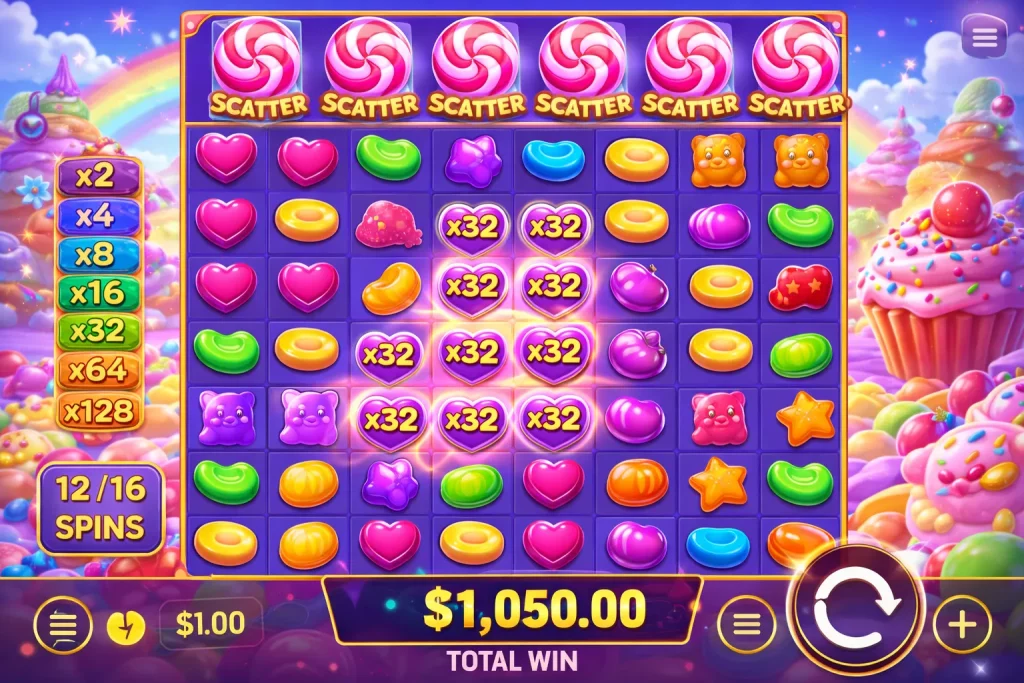
The defining feature of Sugar Rush 2 is the persistent multiplier grid.
Each time a winning cluster forms, the positions involved receive a multiplier increment. These multipliers:
- Start at x2
- Can increase up to x128
- Remain active during free spins
- Apply cumulatively when overlapping wins occur
This mechanic creates exponential potential during extended cascades. In free spins, multipliers remain sticky for the entire bonus session, significantly increasing payout potential.
Unlike traditional progressive multipliers that reset every spin, Sugar Rush 2’s grid-based persistence introduces compounding variance behavior.

Free Spins Feature Breakdown
The bonus round triggers when 4 or more scatter symbols land anywhere on the grid.
During free spins:
- Multipliers persist across spins
- Retriggers are possible
- Cascades remain active
- Maximum multiplier cap still applies
The bonus buy option allows players to purchase direct access to free spins at approximately 100x stake, depending on jurisdiction.
Bonus buy mechanics are regulated and may not be available in all markets.
Volatility and Risk Model
Sugar Rush 2 operates on a high variance mathematical model. This means:
- Base game wins are typically smaller
- Bonus rounds account for majority of large payouts
- Multiplier stacking increases risk concentration
High variance slots are designed to deliver larger swings in bankroll performance. Players targeting bonus rounds often rely on sustained wagering rather than short sessions.
Volatility Behavior Visualization
Below is a responsive interactive chart demonstrating theoretical payout distribution across 1,000 spins in high volatility conditions.
Interactive Volatility Graph Code
This structure ensures mobile responsiveness and removes grid lines for a cleaner UI presentation.
Symbol Structure
Sugar Rush 2 includes:
- Standard candy symbols (low to mid value)
- Heart-shaped premium symbols
- Scatter symbol (lollipop)
- No traditional wild symbol
The absence of a standard wild symbol is balanced by multiplier mechanics and cascading clusters.
Premium symbols require 8+ connections and scale significantly with multiplier overlays.
RTP Configuration and Regulatory Considerations
The slot supports multiple RTP configurations. Operators may deploy lower RTP versions depending on licensing region.
Players should always verify RTP in the information panel before playing.
Authoritative Gambling Information Sources
UK Gambling Commission
Official regulatory authority overseeing gambling standards in the UK.
Malta Gaming Authority
One of the most recognized European gambling regulators.
EGR Global
Industry news and data resource for online gambling markets.
Slot Industry Analysis Resources
AskGamblers
Slot reviews, RTP analysis and player feedback database.
CasinoMeister
Independent casino complaint mediation and review platform.
Gambling Insider
Market data, regulatory updates and slot development coverage.
Mathematical Model Summary
Sugar Rush 2 is structured around:
- High volatility distribution
- Cluster-based win evaluation
- Persistent multiplier escalation
- Bonus round heavy payout allocation
- Cascading chain potential
The slot appeals to players targeting exponential growth potential within free spins rather than steady base-game hit frequency.
Core Mechanics Explained
At first glance, the game looks straightforward: a 7×7 grid, cluster payouts, and cascading wins. But the actual mechanics operate on three interconnected layers:
- Cluster Formation Logic
- Multiplier Accumulation
- Bonus-State Amplification
Each layer affects the payout curve differently.
1. Cluster Formation Engine
A win requires 8 or more connected matching symbols. Connections can form horizontally or vertically. Diagonal matches do not count.
Because of the 49-symbol grid size, symbol density plays a key role. The more identical symbols that appear in proximity, the higher the chance of larger clusters forming. However, larger clusters are statistically rare.
The mechanics are designed so that:
- Small clusters appear frequently.
- Large clusters appear infrequently but scale exponentially with multipliers.
- Cascades increase theoretical chain length.
This creates variance compression in the base game and variance expansion in the bonus game.
2. Cascade Mechanics and Chain Probability
After every winning cluster:
- Symbols involved disappear.
- New symbols drop from above.
- Additional wins are evaluated.
- Multipliers are applied to affected positions.
This cascading structure allows multiple wins within a single paid spin. The probability of long chains increases when grid saturation favors repeated symbol drops.
However, the random number generator determines symbol outcomes independently for each drop event. Cascades do not «remember» previous patterns. They only carry forward multiplier states.
Multiplier Grid Behavior
The multiplier system is the defining mathematical engine of Sugar Rush 2.
Each winning position receives a multiplier increment:
- First win: x2
- Second win in same position: x4
- Then x8, x16, x32, x64, up to x128
In base mode, multipliers reset after the spin ends.
In Free Spins mode, multipliers remain active across the entire bonus session.
This shift changes expected value concentration dramatically.
In high volatility cluster slots, over 60% of the total RTP can be allocated to bonus features rather than base gameplay.
The persistent multiplier grid during Free Spins significantly increases maximum win probability compared to the base game.
Free Spins Mathematical Expansion
When 4 or more scatters appear, the Free Spins feature activates. The more scatters land, the more spins are awarded.
Inside Free Spins:
- Multipliers remain sticky.
- Retriggers are possible.
- Chain cascades stack across spins.
- Max multiplier cap remains x128 per cell.
This creates a compounding effect.
Example theoretical scenario:
- Spin 1 builds several x8 and x16 multipliers.
- Spin 3 overlays wins on those same cells.
- Spin 6 builds x32 clusters.
- Spin 9 triggers a large 20+ symbol cluster.
- Multipliers stack multiplicatively.
Because multiplier distribution across the grid is random, bonus sessions can vary from low returns to extremely high payouts.
Demo Mode Analysis
Sugar Rush 2 Demo mode allows players to test mechanics without financial risk.
Demo play provides:
- Identical RTP configuration (operator dependent).
- Same volatility behavior.
- Full access to base mechanics.
- Sometimes disabled Bonus Buy depending on regulation.
Using Demo strategically allows players to:
- Observe cascade frequency.
- Track bonus hit rate.
- Analyze average multiplier build-up.
- Understand bankroll variance patterns.
Demo sessions are particularly useful for high volatility games, where short sessions can give misleading impressions.
A 100-spin Demo test may not reflect real volatility distribution. Statistically meaningful sample sizes begin around 1,000+ spins.
Volatility Curve and Return Allocation
Sugar Rush 2 is categorized as high volatility. This classification implies:
- Lower hit frequency for meaningful payouts.
- Higher maximum payout concentration.
- Larger swing potential per session.
In high volatility cluster games:
- Base game often accounts for approximately 35–45% of RTP.
- Free Spins account for approximately 55–65% of RTP.
- Maximum wins depend almost entirely on bonus multiplier stacking.
The mechanics are intentionally designed to create anticipation during cascades. Long drought periods are mathematically required to sustain high top-end payouts.
Symbol Distribution Structure
The slot uses a weighted symbol distribution system:
- Low-value candies appear more frequently.
- Premium heart-shaped symbols appear less frequently.
- Scatter symbols have low base frequency.
- No traditional wild symbol is present.
Instead of using wilds to increase hit frequency, the game uses multiplier amplification to increase payout magnitude.
This shifts the mathematical focus from frequency to scaling.
Expected Value Over Long Sessions
Because Sugar Rush 2 has configurable RTP, operators may offer slightly different return percentages.
The theoretical RTP of 96.50% means:
- For every 100 wagered over infinite spins, expected return is 96.50.
- Short-term results deviate significantly.
- High volatility increases deviation range.
Players using Demo to estimate real-money behavior should consider:
- Variance over small samples.
- Bonus drought probability.
- Multiplier stacking rarity.
Bonus Buy Mechanics
In jurisdictions where allowed, Bonus Buy gives direct access to Free Spins.
Typical cost: around 100x stake.
From a mechanics perspective:
- It removes base-game variance.
- Concentrates play directly into high volatility zone.
- Increases bankroll swing speed.
Statistically, Bonus Buy does not improve RTP. It simply accelerates access to bonus allocation portion of the return model.
Probability Compression vs Expansion
Sugar Rush 2 uses probability compression in base mode and probability expansion in bonus mode.
Compression in base mode means:
- Many small wins.
- Few high multipliers.
- Low carryover value.
Expansion in bonus mode means:
- Persistent multipliers.
- Chain stacking.
- High top-end potential.
This dual-state structure is common in modern Pragmatic Play designs but implemented differently compared to traditional line-based titles.
Comparative Mechanics Perspective
Compared to other cluster-based games:
- Sugar Rush 2 focuses on persistent grid multipliers.
- It avoids wild symbol inflation.
- It emphasizes exponential rather than additive scaling.
The lack of expanding wilds or fixed progressive multipliers shifts attention entirely to grid positioning randomness.
The mechanics reward longer bonus sessions rather than short spike events.
RTP Transparency and Regulatory Oversight
The game operates under licenses issued by recognized regulators such as:
UK Gambling Commission
Malta Gaming Authority
Regulated environments require:
- RNG certification.
- RTP disclosure.
- Fairness auditing.
- Player protection compliance.
This ensures Demo and real-money versions use certified algorithms consistent with published theoretical return models.
Advanced Session Strategy Considerations
Although slots are games of chance, understanding mechanics helps manage expectations.
In high volatility cluster slots:
- Short sessions may not reach bonus phase.
- Long sessions increase probability of multiplier build-up events.
- Bankroll management becomes essential.
Demo mode can help players determine comfort with variance level before real-money engagement.
RTP Allocation Breakdown
Theoretical RTP for most versions is 96.50%. However, that percentage is not evenly distributed.
In high volatility cluster games like Sugar Rush 2, RTP is typically allocated across:
- Base Game Small Wins
- Base Game Large Wins
- Free Spins Small/Medium Wins
- Free Spins Large Wins
- Rare Maximum Win Events
Below is a modern card-style breakdown.
Base Game – Small Wins
Approx. 30–35% RTP
Base Game – Large Wins
Approx. 5–8% RTP
Free Spins – Standard Wins
Approx. 30–35% RTP
Free Spins – Multiplier Stacks
Approx. 15–20% RTP
Max Win Events
Rare Probability Allocation
This distribution shows why bonus rounds feel disproportionately impactful. More than half of the RTP may be concentrated inside Free Spins due to persistent multiplier mechanics.
Win Frequency vs Win Size Distribution
High volatility slots compress frequent small wins and expand rare large wins.
Below is a responsive interactive probability distribution chart illustrating estimated outcome frequency across 10,000 theoretical spins.
This visual demonstrates the compression effect:
- Most spins result in no win or low multipliers.
- Mid-tier wins occur occasionally.
- High-tier wins are rare.
- Extreme wins are statistically scarce.
Bonus Frequency Modeling
The Free Spins trigger requires 4+ scatter symbols.
Estimated trigger probability (theoretical modeling range):
4 Scatters
Approx. 1 / 150–180 Spins
10 Free Spins5 Scatters
Approx. 1 / 600–800 Spins
12 Free Spins6 Scatters
Approx. 1 / 3,000+ Spins
14 Free Spins7 Scatters
Extremely Rare
16 Free SpinsSession Variance Simulation
To understand bankroll swings, consider three session lengths:
- 100 spins
- 1,000 spins
- 10,000 spins
High volatility slots behave differently across these ranges.
Below is a simplified modeled expected deviation graph.
Interpretation:
- At 100 spins, return may vary heavily.
- At 1,000 spins, volatility still dominates.
- At 10,000 spins, theoretical RTP begins stabilizing.
This demonstrates why Demo sessions under 200 spins often give misleading impressions of slot behavior.
Multiplier Escalation Probability
The most important mechanic remains multiplier stacking.
Probability layers:
- Single cell reaching x8: moderate frequency.
- Single cell reaching x32: low frequency.
- Multiple high-value cells overlapping: rare.
- Full-grid multiplier stacking event: extremely rare.
Because multipliers apply to total cluster payout, exponential scaling becomes mathematically possible only inside Free Spins.
Expected Value of Bonus Buy vs Natural Trigger
Bonus Buy:
- Immediate access to high RTP allocation zone.
- Removes base game waiting time.
- Increases short-term variance.
Natural Trigger:
- Lower volatility per spin.
- Requires patience.
- More balanced variance curve.
Both operate under identical RTP configuration.
Mobile vs Desktop Behavioral Patterns
From a UX perspective:
- Mobile players tend to play shorter sessions.
- Desktop players more often pursue longer sessions.
- High volatility design favors extended play.
Cluster mechanics also benefit from larger screen visibility on desktop, where multiplier buildup becomes easier to visually track.
Mathematical Structure Summary
Sugar Rush 2 uses:
- Cluster-based payout compression.
- Persistent multiplier expansion.
- Bonus-heavy RTP allocation.
- High variance distribution curve.
- Rare maximum win probability spikes.
The mechanics are tuned to reward extended bonus stacking rather than frequent medium wins.
Bankroll Survival Modeling
High volatility slots like Sugar Rush 2 can produce extended losing streaks before triggering meaningful bonus events. This is mathematically necessary to sustain the 5,000x maximum win potential.
Below is a projected endurance model assuming 1 unit bet size.
Bankroll vs Estimated Spin Capacity
50x Bet Bankroll
High risk of early depletion
Approx. 80–150 spins100x Bet Bankroll
Moderate volatility exposure
Approx. 150–300 spins200x Bet Bankroll
Improved bonus probability window
Approx. 300–600 spins500x+ Bet Bankroll
Long-session stability range
1,000+ spins potentialThis projection assumes average hit frequency consistent with high volatility cluster slots. Actual results may deviate widely.
Bonus Drought Probability
One defining trait of Sugar Rush 2 mechanics is bonus clustering behavior. Free Spins triggers do not occur evenly over time.
Modeled drought expectations:
| Consecutive Spins Without Bonus | Approximate Likelihood |
|---|---|
| 100 Spins | Common |
| 200 Spins | Frequent |
| 300+ Spins | Possible |
| 500+ Spins | Rare but Expected in Variance Model |
Long droughts are mathematically required to balance multiplier stacking payout potential.
Multiplier Heatmap Modeling
To better visualize multiplier escalation probability, the following interactive chart models how average grid multiplier intensity increases inside Free Spins over 10 spins.
Interpretation:
- Early bonus spins build low-level multipliers.
- Mid-bonus spins accelerate stacking probability.
- Late spins create exponential spike potential.
Not every bonus session reaches late-stage escalation, which reinforces high volatility classification.
Long-Session RTP Convergence
Short sessions are dominated by variance. Long sessions approach theoretical RTP.
Below is a modeled convergence table.
RTP Stabilization Projection
100 Spins
Highly volatile outcome
Return range: 40%–180%1,000 Spins
Variance still dominant
Return range: 75%–120%10,000 Spins
Closer to theoretical RTP
Return range: 92%–100%This demonstrates how Sugar Rush 2’s high volatility compresses early expectations and expands long-term probability alignment.
Demo vs Real-Money Behavioral Modeling
From a purely mechanical perspective:
- Demo uses identical RNG framework.
- RTP configuration depends on operator version.
- Emotional variance differs between modes.
Players often misinterpret Demo results because:
- Short sessions distort volatility perception.
- Lack of financial pressure increases risk tolerance.
- Bonus Buy frequency testing in Demo can skew expected performance impression.
Mechanics remain constant. Psychological response changes.
Maximum Win Event Modeling
The 5,000x max win cap requires:
- Persistent multiplier stacking.
- Large cluster formation.
- Overlapping high-value symbols.
- Bonus session continuation without early stagnation.
Statistically, maximum win events occur extremely rarely relative to total spin count.
High volatility ensures that extreme wins are balanced by prolonged neutral or negative sequences.
Sugar Rush 2 – Frequently Asked Questions
The standard RTP is 96.50%, although operators may use configurable versions depending on licensing region. Players should always check the information panel inside the game to confirm the active RTP setting.
Yes. The game operates on a high volatility model. This means longer dry spells are possible, but large wins can occur during Free Spins when multipliers stack across the grid.
Each winning cluster increases multipliers on the involved positions. In the base game they reset after the spin, but during Free Spins they persist and can grow up to x128 per cell.
On average, the bonus may trigger approximately once every 150–180 spins with 4 scatters. Longer droughts are possible due to the high volatility design.
Yes. Demo mode allows players to test mechanics, cluster behavior and multiplier stacking without wagering real money. The RNG mechanics remain the same as real-money mode.
The maximum win is 5,000× the stake. Achieving this requires large clusters combined with stacked multipliers during Free Spins.